
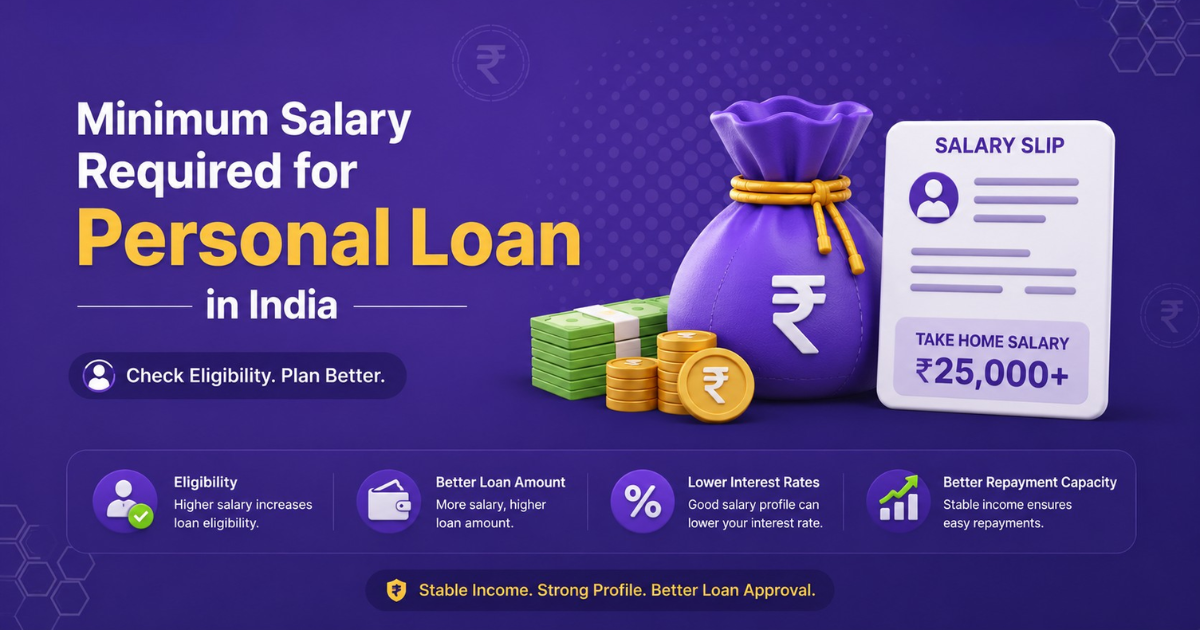
Understanding the minimum salary for personal loan approval is important before applying with any lender in India. In the rapidly evolving financial landscape of 2026, personal loans have shifted from being mere emergency lifelines to becoming strategic financial tools for debt consolidation, major life events, and cash flow management. As central banks maintain a cautious stance with interest rates remaining above pre-pandemic levels, lenders have moved away from static numerical thresholds to more dynamic, context-aware risk assessments.
For many borrowers, the most pressing question remains: “What is the minimum salary I need to qualify?” If you are exploring instant personal loan apps in India with quick approval, understanding eligibility factors is important. While the answer depends on several variables, including your credit history and debt-to-income (DTI) ratio, this comprehensive guide will break down exactly what you need to secure a personal loan in 2026. You can also apply for an instant personal loan online without paperwork through digital platforms., specifically through the lens of MoneyMonk, a leading digital financing platform.
1. Minimum Salary for Personal Loan in 2026
In 2026, financial institutions no longer view your income as just a simple number; they prioritize “income durability” the consistency and verifiability of your cash flow under various economic conditions.
The MoneyMonk Standard
To be eligible for a personal loan through the MoneyMonk platform, applicants must meet the following core income criteria. Before applying, it is always better to check your personal loan eligibility online instantly.
- Monthly Salary: A stable monthly source of income of at least ₹18,000.
- Annual Household Income: A total annual household income greater than ₹3 Lakhs.
While some specialized lenders in the global market might accept a lower floor of roughly $12,000 (approximately ₹83,000 per month in some regions), MoneyMonk focuses on providing accessible credit to salaried and self-employed professionals who demonstrate a reliable baseline of earnings.
2. Why Salary is Only Part of the Story: Understanding Income Durability
While meeting the minimum salary requirement is a vital first step. You can also check loan eligibility without affecting your credit score before applying. lenders in 2026 are deeply invested in how “clean” your income profile is. They aren’t just looking at the amount on your paycheck; they are looking for uninterrupted cash flow.
Factors Lenders Use to Judge Your Salary:
- Verifiability: Can your income be proven through bank statements and digital authentication? MoneyMonk simplifies this by using a fully digital process that shares data through your authentication and consent, eliminating the need for manual document uploads.
- Consistency: Lenders look for a fixed salary credit date and a consistent employer name in your bank narrations. Irregular deposits or third-party payments can be flagged as signs of instability.
- Employment Type: Salaried employees are often viewed as lower risk due to the predictability of their income. However, the 2026 market has seen a massive shift toward inclusive models that also support self-employed individuals and those in the gig economy, provided they can show a track record of stable earnings.
3. The True Gatekeeper: The Debt-to-Income (DTI) Ratio
Even if you earn a high salary, you might still be denied a loan. It is always smart to manage your personal loan eligibility using digital tools. if too much of that income is already “spoken for” by other debts. This is measured by the Debt-to-Income (DTI) ratio, or the Fixed Obligation to Income Ratio (FOIR).
How to Calculate Your DTI:
You can calculate this by adding all your monthly debt payments and dividing them by your gross monthly income:
Monthly Debt Payments ÷ Gross Monthly Income x 100 = DTI%
Benchmarks for 2026:
- Ideal (Below 30%): You are in excellent shape to unlock the best interest rates and higher loan amounts.
- Standard (31% – 36%): Most lenders consider this a healthy and manageable range.
- High Risk (Above 45%): Many lenders prefer DTI ratios below 45%, as a ratio higher than this indicates you may struggle to take on new debt responsibly.
MoneyMonk emphasizes that approval and eligibility are known instantly, as the platform’s proprietary underwriting accounts for your current financial obligations to ensure you don’t over-leverage yourself.
4. The Role of Credit Scores in Salary Requirements
In 2026, your credit score acts as a multiplier for your salary. You can check your loan eligibility in just a few seconds before applying to improve approval chances. A high credit score can sometimes help offset a slightly lower income by demonstrating that you are an exceptionally responsible borrower.
- Excellent Credit (800+): You have a nearly 90% chance of approval and can secure the lowest interest rates, starting as low as 12% per annum on MoneyMonk.
- Good/Very Good (670 – 799): You are likely to qualify for higher loan limits and competitive rates.
- Fair Credit (580 – 669): Approval chances drop significantly (to about 21%), and you may be offered smaller loan amounts with higher interest rates.
- Poor Credit (Below 580): Borrowers in this tier have a less than 1% chance of prequalification through traditional marketplaces.
5. Salaried vs. Self-Employed: Divergent Paths to Approval
Your employment status fundamentally changes how a lender scrutinizes your salary. Always choose reliable personal loan platforms with transparent processes.
For Salaried Professionals
- Perception: Lower risk due to steady monthly income.
- Documentation: Usually requires salary slips (last 3-6 months), bank statements, and Form 16.
- MoneyMonk Advantage: Salaried professionals can often complete the entire application in under 15 minutes, with immediate disbursal upon approval.
For Self-Employed Professionals
- Perception: Higher risk due to fluctuating business revenues.
- Requirements: Lenders typically look for 12-36 months of business continuity.
- The “Income Haircut”: Lenders often apply a buffer (around 20%) to business income to account for volatility when calculating your repayment capacity.
MoneyMonk is designed to serve both segments, utilizing digital KYC and video-based verification to make the process equitable for both employees and entrepreneurs.
6. How Much Can You Actually Get?
Just because you meet the minimum salary requirement doesn’t mean you will qualify for a massive loan. You should always compare personal loan platforms with transparent terms before applying. Loan amounts are typically capped based on your income level.
- General Limits: Most digital lenders in 2026 cap personal loans between ₹20,000 and ₹3 Lakhs for standard products.
- MoneyMonk Limits: MoneyMonk offers personal loans ranging from ₹25,000 to ₹3 Lakhs (and up to ₹2 Lakhs for specific salary advance products).
- The Salary Multiplier: In many regions, personal loans are capped at roughly 20 times your monthly salary to prevent over-indebtedness.
7. The 2026 Shift: “Verification Friction” and AI Underwriting
One of the biggest trends in 2026 is the rise of “Verification Friction”. Modern lenders, including MoneyMonk, are moving away from manually reviewing scanned documents and toward AI-powered underwriting.
What This Means for You:
- No Scanned Documents: Platforms now prioritize data shared through secure authentication rather than manual uploads.
- Instant Decisions: AI agents monitor “self-executing financial flows” to predict your future income stability, allowing for instant eligibility checks.
- Digital Identity: Your Aadhaar must be linked with your PAN, and your registered mobile number must be linked to your Aadhaar for e-signing the loan agreement.
8. Step-by-Step: Applying with a Minimum Salary on MoneyMonk
If you meet the ₹18,000 monthly salary requirement, here is how you can secure your funds. You can start your personal loan application instantly from your mobile and get faster approvals. through the MoneyMonk app:
- Download & Register: Install the MoneyMonk app from the Play Store and register using your mobile number or Gmail.
- Eligibility Check: Fill in basic details to see your instant eligibility and maximum loan amount.
- Video KYC: Perform a quick Video KYC to verify your identity.
- Bank Details: Provide your bank account details for direct fund disbursement.
- E-Sign & E-Nach: Sign the digital loan agreement and set up your automated repayment (E-Nach).
- Receive Funds: Once approved, the loan amount is typically received in your account instantly.
9. Improving Your Odds: Tips for Low-Salary Borrowers
If you are earning near the minimum threshold, follow these strategies to enhance your profile:
- Maintain Continuous Employment: Banks value an uninterrupted work history; try to stay with your current employer for at least 6-12 months before applying.
- Lower Your DTI: Pay down smaller credit card balances to free up more of your income for the new loan.
- Consistent Salary Credits: Ensure your salary is credited to the same bank account every month to prove income stability.
- Avoid “Job-Hopping”: Frequent changes without a clear upward trajectory can signal risk to lenders.
If your application was declined earlier, understand the common issues and solutions in our detailed guide on top reasons why personal loans get rejected
10. Conclusion: Managing Your Money Like a Monk
The financial world of 2026 offers more flexibility than ever, but it also requires more responsibility. Whether you are seeking a loan for school fees, home renovation, or debt consolidation, understanding the minimum salary and eligibility requirements is your first step toward financial freedom.
MoneyMonk (owned by the RBI-registered NBFC, Monk Capital Pvt Ltd) provides a 100% digital, transparent, and compliant way to access funds quickly. By focusing on income durability and leveraging AI-powered verification, we ensure that qualified borrowers can get the support they need with “peace of mind”.
Ready to see your offer?
You can apply for a personal loan on the official website or download the app for instant approval and quick access.
FAQs
Most platforms, including MoneyMonk, require at least ₹18,000 for standard personal loans to ensure you can comfortably meet the 12% to 36% interest rates and repayment schedules.
Not necessarily, but there is a strong correlation. Higher incomes provide a larger “safety buffer,” which often leads to lower APRs, even independent of your credit score.
Defaulting on a payment can lead to a per-day penalty charge (annualized at 36%) and will significantly damage your credit score, making you ineligible for future loans from MoneyMonk.
Yes. From checking eligibility to Video KYC and e-signing the loan agreement, MoneyMonk offers a fully online process that eliminates the need for physical branch visits or paper documents.





Leave a Reply