
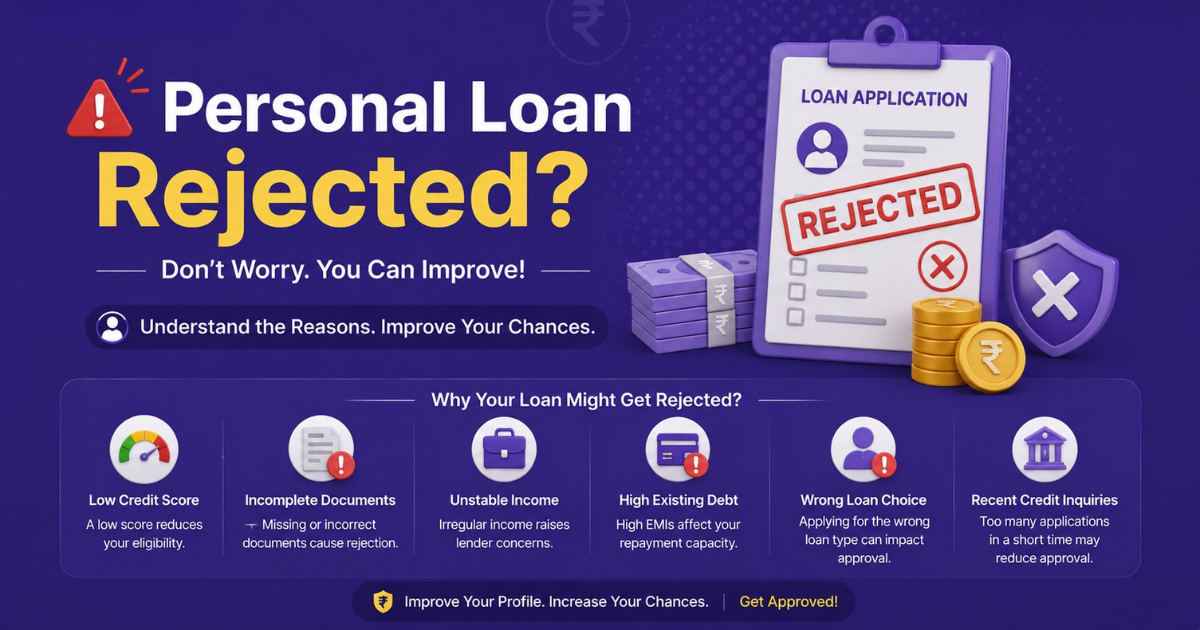
If your personal loan rejected application caused confusion, understanding the exact reasons can help improve your approval chances next time. Securing a personal loan in India has transitioned from a manual, weeks-long ordeal to a digital-first experience that can often be completed in minutes. Platforms like MoneyMonk have pioneered this shift, offering seamless, 100% digital journeys for loans ranging from ₹25,000 to ₹3,00,000. If you are exploring instant personal loan apps in India with fast approval, choosing the right platform is important.
However, despite the technological advancements, the “rejection letter” remains a common reality. For many, a personal loan rejection feels like a sudden roadblock in a well-planned financial journey. But here is the truth: loan rejections are not arbitrary. They follow a sophisticated underwriting architecture designed to mitigate risk.
If you have faced a decline, understanding the “Why” is the first step toward the “Fix.” You can also check your personal loan eligibility online instantly before applying again. This comprehensive guide delves into the structural dynamics of loan rejections and provides an authoritative roadmap to transform your profile from “rejected” to “approved.”
1. The “King” of Approvals: Decoding the CIBIL Score Factor
In the Indian lending ecosystem, your credit score is the primary diagnostic tool lenders use. Today, many users prefer to check loan eligibility without affecting their credit score before applying. This three-digit number, ranging from 300 to 900, acts as your financial report card.
The Quantitative Risk Bands
Lenders utilize specific numerical thresholds to categorize applicants. While requirements vary, the general interpretation is:
| CIBIL Score Range | Interpretation | Approval Outlook |
| 750 – 900 | Excellent | Very High; eligible for best rates |
| 700 – 749 | Good | High; competitive interest rates |
| 650 – 699 | Fair | Moderate; may face stricter terms |
| Below 650 | Poor/Sub-prime | Low; likely rejection from traditional banks |
Why Your Score Might Be Low
- Payment History (35% weight): This is the most critical pillar. Even a single 30-day delay in an EMI or credit card payment can decimate your score by 50 to 100 points.
- Credit Utilization Ratio (30% weight): This measures how much of your available credit limit you are using. Lenders view a ratio exceeding 30-40% as a sign of “credit hunger.” It is always better to manage your personal loan eligibility using digital tools before taking another loan or financial over-extension.
- Thin Credit Depth: You might have a score of 780, but if it is derived from a single, low-limit card with only three months of history, a lender may still decline you for “insufficient credit depth”.
The Fix: If your score is the issue, focus on the “30-30 Rule.” Keep your credit utilization below 30% and ensure 100% on-time payments for at least 6 months before reapplying.
2. Mathematical Thresholds: The FOIR and DTI Analysis
Beyond the credit score, the most frequent reason for personal loan rejection is a lack of “repayment capacity.” You should always compare personal loan platforms with transparent terms before applying. Lenders measure this through the Fixed Obligation to Income Ratio (FOIR) or the Debt-to-Income (DTI) ratio.
The Underwriting Formula
Lenders want to ensure that a new EMI won’t push you into a financial deficit. The formula typically used is:
FOIR=(Existing Monthly EMIs +Proposed Loan EMI / Net Monthly Income )×100
Rejection Triggers
Most major lenders prefer an FOIR that does not exceed 40% to 50%.
- Scenario: If you earn ₹60,000 and your existing EMIs total ₹35,000, your FOIR is 58.3%. This is considered “Critical” and often leads to automatic rejection because more than half of your income is already diverted to debt servicing.
- High Income Myth: A common misconception is that a high salary offsets a high FOIR. Even someone earning ₹5 Lakh per month can be rejected if their existing liabilities consume ₹4 Lakh of that income.
The Fix: Lower your FOIR by prepaying small-ticket debts (like consumer durable loans or small credit card balances) before applying for a major personal loan.
To understand all the factors lenders evaluate before approving your application, read our complete guide on personal loan eligibility in India
3. The Professional Stratification: Employer Tiers
A unique feature of Indian lending is the categorization of employers based on perceived stability. Where you work significantly influences your eligibility and interest rates. Always choose reliable personal loan platforms with transparent processes for better approval chances.
The Tiering System
- Super A / Platinum: Fortune 500 companies, blue-chip conglomerates, and central government employees. These applicants enjoy near-instant approvals and the lowest rates.
- Category A / Gold: Established listed companies with low employee churn.
- Category B / Silver: Reputable mid-sized private limited firms.
- Unlisted / Startups: Employees of very small firms or early-stage startups often face higher rejection rates or “High Scrutiny” because lenders fear sudden salary delays or company closures.
Job Instability and Probation
Lenders equate “frequent job changes” with financial risk. Most institutions require at least 6 to 12 months of uninterrupted work with the current employer. If you are currently on probation, many lenders will decline your application until your employment is confirmed.
The Fix: Try to maintain at least one year of stability in a job before seeking a significant loan. If you work for a startup or an unlisted firm, applying through a tech-forward platform like MoneyMonk can be more effective, as they specialize in digital-first assessments for modern professionals.
4. The Silent Killer: The Rejection Spiral of Multiple Inquiries
When borrowers are desperate for funds, they often install multiple lending apps and apply simultaneously. Instead, you can apply for a personal loan through a trusted digital platform to avoid multiple rejections. This triggers a cascading drop in their credit score a phenomenon known as the “Rejection Spiral”.
Hard Inquiry Impact
Every formal application triggers a “hard inquiry,” which temporarily reduces your score by 5 to 50 points.
- Application 1: Score drops from 750 to 720.
- Application 2 (within 7 days): Score drops to 685 as the bureau flags “credit-seeking behavior”.
- Application 3 (within 14 days): Score plummets to 645, making you “sub-prime” and ensuring rejection across all platforms.
Lenders interpret multiple inquiries within 30 days as a sign of financial distress or an attempt to hide undisclosed debt.
The Fix: Avoid “app shopping.” Wait at least 30 to 90 days between applications to let hard inquiries age off your report. Use soft inquiry tools (which don’t hurt your score) to check eligibility first.
5. Digital Onboarding Barriers: KYC and Compliance Failures
In today’s digital lending environment, technical rejections are just as common as financial ones. Today, you can complete your personal loan process digitally in minutes with secure verification systems.
Discrepancies in Data
Under RBI mandates, all customer data must be current and verifiable against official databases.
- Name Variation: If your Aadhaar says “Priya Sharma” but your PAN says “Priya S.”, character mismatches can trigger automatic rejections.
- Address Inconsistency: Even minor spelling differences between your application and your Aadhaar can flag a discrepancy.
- Video KYC (V-CIP) Failures: Poor lighting, using pre-recorded videos, or not being physically present in India during the call are common reasons for instant digital rejection.
The Fix: Ensure 100% character-match across all official documents. Update your KYC records (Aadhaar/PAN) to reflect consistent details before starting a digital application.
6. Geographic Risk and Negative Pincodes
Lenders maintain “Negative Pincode Lists” specific areas where historical data shows high frequencies of defaults, fraud, or difficulties in physical verification. If your residential or office pincode is blacklisted, your application may be rejected instantly, even with a 750+ CIBIL score and a high salary.
The Fix: If you live in a localized default cluster, providing a permanent address proof from a “positive” pincode or applying through a lender with a strong branch presence in your specific locality can sometimes mitigate this risk.
7. The Profile Funding Scam: A Growing Threat
A rising cause of rejections is the “Profile Funding” scam. Scammers trick individuals into sharing financial documents for an “investment” or “buy-back” scheme, using the victim’s strong profile to take out large loans. When the scammer stops paying the EMIs, the bank holds the individual responsible. This single factor has damaged more CIBIL scores in the 2024-2025 period than almost any other.
The Fix: Never share your sensitive financial documents or OTPs with third-party “agents” promising commissions.Only apply through official platforms like the MoneyMonk app. You can also start your personal loan application instantly from your mobile safely and securely.
8. The Authority Blueprint: Strategic Fixes for Loan Rejection
If your loan has been declined, don’t panic. Follow this systematic remediation blueprint to rebuild your creditworthiness over a 3 to 6-month cooling-off period.
Step 1: Obtain Your Full Credit Report
Download your complete report from CIBIL, Experian, and CRIF High Mark. Verify every entry. It is estimated that 20% of credit reports contain errors, such as closed accounts still showing as “Active”.
Step 2: Fix the “Settled” Status Trap
A major hurdle is a “Settled” tag. This happens when you pay only a portion of dues to close a delinquent account. Lenders see this as a sign of credit failure.
- The Fix: Contact the original lender, pay the remaining “waived” amount in full, and obtain a No Dues Certificate (NOC). Once the status changes to “Closed,” your creditworthiness is restored.
Step 3: Optimize Your FOIR
During your cooling-off period, focus on closing small, high-interest debts. Reducing the number of active EMIs directly improves your mathematical repayment capacity.
Step 4: Build Credit via Secured Products
If you have a “poor” score (below 600) or no credit history (“thin file”), the most effective tool is a Secured Credit Card issued against a Fixed Deposit (FD). Using this card for minor expenses and paying the bill in full each month builds a positive repayment history, which constitutes 35% of your CIBIL score.
Why Choose MoneyMonk?
When traditional paths fail, choosing a tech-forward, RBI-registered partner is key. MoneyMonk, operated by Monk Capital Pvt Ltd, offers a personal loan journey that is different by design:
- 100% Digital & Compliant: No need to upload scanned documents; data is shared through secure authentication and consent.
- Fast Processing: The entire process generally takes no more than 15 minutes, with disbursement done in minutes after approval.
- Transparent Terms: MoneyMonk provides a Key Fact Statement as required by the RBI, ensuring no hidden charges.
- Specialized Products: Offering salary advance loans and short-term personal loans (₹25,000 to ₹2,00,000) with flexible tenures of 2 to 6 EMIs.
MoneyMonk Eligibility Checklist:
- Indian Citizen, aged 21+.
- Stable monthly income above ₹18,000.
- Aadhaar linked with PAN and a mobile number for e-signing.
Conclusion: The Path Toward Credit Restoration
Rejection is not a permanent verdict; it is a systemic outcome of the current underwriting environment. As the RBI tightens norms on unsecured lending, the “margin for error” for borrowers has shrunk.
To move from rejection to approval, you must adopt a “credit repair” mindset. This involves FOIR optimization, meticulous document verification, and avoiding the “rejection spiral” of multiple simultaneous inquiries. By following the fixes outlined in this guide and choosing a reliable partner like MoneyMonk, you can apply for a personal loan on the official website or download the app for instant approval and quick access, you can navigate the complexities of the Indian credit ecosystem and secure the funding you need with peace of mind.
Frequently Asked Questions (FAQs)
1. Can my loan be rejected even with a 750+ CIBIL score?
Yes. A high score represents past discipline, but it does not guarantee current repayment capacity. Rejection can still occur due to high FOIR, unstable income, documentation mismatches, or working in a “negative profile” industry.
2. How long should I wait to reapply after a rejection?
Lenders and experts recommend a mandatory waiting period of 3 to 6 months. This allows hard inquiries to age and gives you a window to improve your financial profile.
3. Does checking my own credit score hurt my CIBIL?
No. Checking your own score is a “soft inquiry” and has zero impact on your CIBIL score. It is a vital part of managing your financial health.
4. Why is my “Settled” loan account a problem?
A “Settled” status indicates that the lender lost money on your account. New lenders view this as a high risk and may reject your application or charge significantly higher interest rates.
5. What is the minimum income required for a MoneyMonk loan?
To be eligible for a personal loan through MoneyMonk, you must have a stable monthly source of income above ₹18,000.


Leave a Reply