
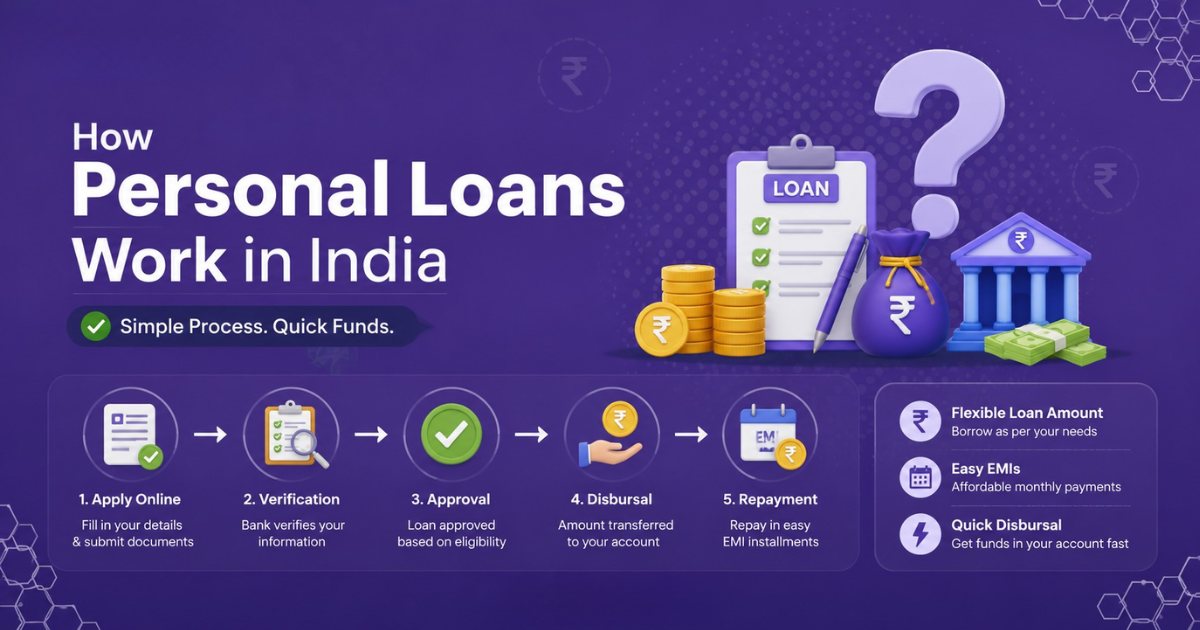
Understanding how personal loans work helps borrowers make smarter financial decisions and improve loan approval chances in India. In today’s fast-paced economy, financial flexibility isn’t just a luxury it’s a necessity. Whether you are planning a dream wedding, handling a sudden medical emergency, or looking to renovate your home, personal loans have emerged as the most versatile tool in an Indian borrower’s toolkit. If you are exploring instant personal loan apps in India with fast approval, understanding how they work is essential before you apply.
If you have ever wondered exactly how personal loans work in India, you are in the right place. As an expert in the financial space with over a decade of experience, I have seen the transition from long bank queues to 5-minute digital approvals firsthand. This comprehensive guide will walk you through every nuance of the process, ensuring you can navigate the world of unsecured credit with the wisdom of a financial monk.
How Personal Loans Work in India
At its core, a personal loan is a type of unsecured borrowing from a financial institution like a bank or an NBFC (Non-Banking Financial Company). Unlike a home loan or a car loan, which are “secured” by the asset you are buying, a personal loan requires no collateral. You don’t need to pledge your house, gold, or stocks to get the funds you need.
The Versatility Factor
The most significant market driver for personal loans in India is their end-use flexibility. Lenders generally do not track or restrict how you use the money. Common uses include:
- Wedding Expenses: Managing everything from venue bookings to jewelry.
- Travel: Funding international vacations without draining life savings.
- Medical Needs: Covering urgent hospital bills and procedures.
- Education: Paying for higher studies or specialized skill development programs.
- Home Renovation: Revamping your living space to reflect your style.
- Debt Consolidation: Paying off high-interest credit card bills with a single, lower-interest EMI.
To explore different borrowing options based on your financial needs, check our complete guide on types of personal loans in India.
Chapter 1: How Personal Loans Work with Eligibility Criteria
When you take a personal loan, the lender provides you with a lump-sum amount in your bank account once approved. This principal amount, plus interest, is then repaid over a fixed tenure through Equated Monthly Installments (EMIs).
The 2026 Digital Shift
In 2024 and 2025, the Indian lending market underwent a massive digital transformation. Today, platforms like MoneyMonk have reduced the entire lifecycle from application to disbursal to a matter of minutes. You can now apply for an instant personal loan online without paperwork and avoid traditional delays. Modern lending uses algorithms, AI-based credit models, and real-time APIs to assess your creditworthiness instantly, moving away from the slow, manual checks of the past.
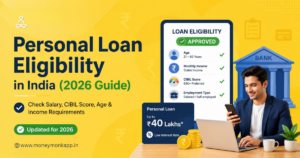
Chapter 2: Eligibility Criteria – Can You Get a Loan?
Before you apply, you must understand the “matrix of variables” that lenders use to establish your repayment capacity. It is always better to check your personal loan eligibility online instantly before applying. In India, eligibility is determined by your demographic and financial profile.
1. Age Requirements
Most lenders require you to be at least 21 years old. For salaried individuals, the upper age limit is usually 58 to 60 years, while self-employed professionals may be eligible up to 65 years.
2. Income Thresholds
Your income is the primary metric for an unsecured loan because there is no collateral to fall back on.
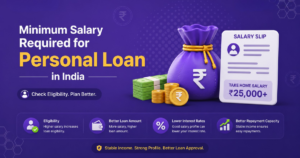
- Salaried Employees: Generally need a minimum monthly income of ₹15,000 to ₹25,000, depending on the city of residence.
- Self-Employed Individuals: Lenders look for an annual profit between ₹2.5 lakh and ₹5 lakh.
3. Employment & Business Stability
Lenders prefer “stable” borrowers. For salaried individuals, this typically means at least 1 to 2 years of total work experience and at least 1 year with the current employer. For those running a business, a “business vintage” of at least 3 years is usually required to prove long-term viability.
4. The FOIR Calculation (Fixed Obligation to Income Ratio)
This is a technical term every borrower should know. Lenders calculate your FOIR to see how much of your monthly income is already going toward existing debts.
- Most lenders set a ceiling of 40% to 50%.
- Example: If you earn ₹50,000 and already pay ₹10,000 in EMIs, your FOIR is 20%. A lender might allow a new loan EMI up to ₹15,000 to keep your total obligations under the 50% (₹25,000) threshold.
Chapter 3: How Personal Loans Work with Credit Scores
Your CIBIL score is the most critical deciding factor in your personal loan journey. Many platforms now allow you to check loan eligibility without affecting your credit score, helping you make smarter decisions. It is a three-digit summary of your entire credit history.
- 750 and Above: This is the “Gold Standard”. Borrowers in this range enjoy approval rates exceeding 80% and are offered the lowest interest rates.
- 650 to 700: Many fintechs and NBFCs now accept scores in this range, though you might face slightly higher interest rates or processing fees.
- Below 650: Approval rates drop significantly (under 30%), and the terms offered may be much stricter.
- Expert Tip: Avoid “Credit Hunger.” Applying to multiple lenders simultaneously to check rates can trigger multiple “hard pulls” on your report, which can paradoxically lower your score. Platforms like MoneyMonk offer instant eligibility checks that are designed to be user-friendly.
Chapter 4: The Documentation Lifecycle
The beauty of modern digital lending is the minimal paperwork. Today, you can complete your personal loan process digitally in minutes without handling physical documents. While traditional banks might still ask for physical copies, digital platforms like MoneyMonk use authentication and consent-based data sharing.
Standard Document Checklist:
| Category | Required Evidence |
| Identity Proof | PAN Card (Mandatory), Aadhaar, Passport, or Voter ID. |
| Address Proof | Aadhaar, Utility Bills (Electricity/Water), or Rental Agreement. |
| Income Proof (Salaried) | Last 3 months’ salary slips and 6 months’ bank statements. |
| Income Proof (Self-Employed) | 2 years of audited ITR, P&L statements, and GST certificates. |
| Employment/Business Proof | Offer letter, Employee ID, or Business registration license. |
The Aadhaar-PAN Link: In 2026, it is crucial that your Aadhaar is linked to your PAN and your registered mobile number. This allows for eKYC and digital signing, which are the engines of instant disbursal.
Chapter 5: How Personal Loans Work Step by Step
Understanding the journey from “App Download” to “Cash in Bank” helps you stay prepared. You can now start your personal loan application instantly from your mobile and get faster approvals.
Step 1: Strategic Assessment & Eligibility Check
Before applying, use a digital eligibility calculator. Enter your income, expenses, and age to see the maximum amount you qualify for. This helps you set realistic expectations and prevents loan rejection.
Step 2: Formal Application
Fill out the application form with accurate personal and employment details. Misinformation at this stage is a leading cause of rejection.
Step 3: Digital Verification (The Speed Engine)
This is where the magic happens.
- eKYC: Your identity is verified through Aadhaar-based OTP or biometric scans.
- Video KYC (V-KYC): A quick live video call where you show your original PAN card and provide a live signature. AI matches your face with your ID document in real-time.
- Account Aggregators: Some digital lenders use this RBI-licensed framework to fetch your bank statements directly from your bank, eliminating the need to upload PDFs.
Step 4: Credit Assessment & Decision
The lender’s algorithm (or credit team) reviews your FOIR, repayment history, and employment stability. If you meet the criteria, you receive a Sanction Letter.
Step 5: Accepting the Offer & The KFS
The Key Fact Statement (KFS) is a regulatory requirement as of 2024. It is a standardized document that must clearly show:
- The Annual Percentage Rate (APR): The total cost of the loan including interest and all fees.
- Detailed repayment schedule.
- Penal charges for defaults.
Step 6: E-Signing the Agreement
Gone are the days of wet-ink signatures for most loans. You will receive a link to a digital contract, which you sign using an OTP sent to your Aadhaar-linked mobile number. This is legally binding under the Information Technology Act.
Step 7: Setting Up the NACH/e-Mandate
Before disbursal, you must authorize the lender to automatically debit your EMIs.
- e-NACH: Can be set up instantly via Net Banking or Debit Card authentication.
- It typically takes 24 to 48 hours to activate.
Step 8: Disbursal
Once the mandate is set, the funds are credited directly to your bank account. On platforms like MoneyMonk, this can happen almost immediately after approval.
Chapter 6: How Personal Loans Work with Interest Rates
The “price” of your loan isn’t just the interest rate; it’s how that interest is calculated. Always choose transparent personal loan platforms with no hidden charges to avoid extra costs.
Flat Rate vs. Reducing Balance
This is the most common pitfall for new borrowers.
- Flat Rate: Interest is calculated on the original principal for the entire tenure.
- Reducing Balance: Interest is calculated only on the outstanding principal each month.
- Why it matters: A 10% Flat Rate is effectively almost double the cost of a 10% Reducing Balance rate. Always look for the Reducing Balance method, which is the standard for reputable lenders.
Interest Rate Ranges
As of February 2025, personal loan rates in India typically range from 9.99% to 44% per annum.
MoneyMonk offers dynamic rates starting from 12% up to 36%, depending on your risk profile.
Chapter 7: Fees, Charges, and the “Hidden” Costs
To avoid surprises, you must look beyond the interest rate.
- Processing Fees: A one-time fee, usually 1% to 3% of the loan amount, deducted upfront from your disbursal.
- GST: Remember that an 18% Goods and Services Tax (GST) applies to all fees (processing, penal, etc.), though not on the interest itself.
- Penal Charges: As of April 1, 2024, the RBI replaced “penal interest” with Penal Charges. Lenders can no longer compound penalties (add them to your principal). They must be reasonable flat fees approved by the board.
- Prepayment/Foreclosure Fees:
Floating Rate Loans: RBI prohibits foreclosure charges for individual borrowers. - Fixed Rate Loans: Lenders may charge 2% to 5% if you close the loan early.
Chapter 8: Repayment Discipline – Staying on Track
Repayment is handled through the NACH system. To stay on track, you can manage your personal loan smartly with digital tools and avoid missed EMIs. It ensures your EMIs are paid on time, protecting your credit score.
What Happens if You Miss an EMI?
- Penalties: You will incur daily per-day penalty charges.
- Double Fees: You might face a “bank bounce fee” from your bank AND an “EMI bounce fee” from your lender.
- Credit Impact: Delayed payments are reported to bureaus (CIBIL/CRIF), which can lower your score and make you ineligible for future loans.
- NPA Status: If an EMI remains unpaid for more than 90 days, the account is classified as a Non-Performing Asset (NPA).
Chapter 9: The MoneyMonk Advantage – Why Digital Wins
While traditional banking has its place, the MoneyMonk app is designed for the modern Indian who values time and transparency. You can apply for a personal loan in minutes and get fast approval without delays.
- Speed: A process that generally takes no more than 15 minutes.
- Accessibility: Available on Android for instant access anytime, anywhere.
- Transparency: No hidden charges; all costs are disclosed upfront in the Sanction Letter and KFS.
- Compliance: Owned by an RBI-registered NBFC, ensuring your data is secured and rules are followed.
Chapter 10: 5 Mistakes to Avoid When Taking a Personal Loan
- Over-Borrowing: Just because you are eligible for ₹5 lakh doesn’t mean you should take it. Borrow only what you need to keep your EMIs comfortable.
- Ignoring the APR: Don’t just compare interest rates. Look at the APR in the Key Fact Statement to see the true total cost.
- Short Tenure Traps: A very short tenure might seem good to close the loan fast, but ensure the higher EMI doesn’t choke your monthly cash flow.
- Hidden Inaccuracies: Ensure your application details exactly match your documents to avoid instant rejection.
- Failing to Maintain Separate Accounts: If you are self-employed, keep business and personal bank accounts separate to make income verification easier for lenders.
Conclusion: Empower Your Financial Future
Understanding how personal loans work in India is the first step toward responsible financial management. The shift toward transparency driven by RBI reforms like the Key Fact Statement and Penal Charge regulations has made the 2026 lending environment safer for consumers than ever before.
When you choose a partner like MoneyMonk, you aren’t just getting a loan; you are gaining a digital companion that values speed, security, and simplicity. By staying informed about your FOIR, maintaining a healthy credit score, and reading the fine print of your APR, you can use personal loans as a powerful springboard to achieve your life goals.
Ready to start your journey?
You can apply for a personal loan on the official website or download the app for instant approval and quick access.
Frequently Asked Questions (FAQs)
Through digital platforms like MoneyMonk, the amount is typically received instantly after the e-sign and mandate setup are complete. Traditional banks may take 3 to 7 business days.
Yes, many lenders have a minimum income requirement of ₹15,000. However, your eligible loan amount will depend on your existing expenses and credit score.
As per 2024 digital lending guidelines, borrowers have a “look-up” period (usually at least 3 days) during which they can cancel the loan by paying only the principal and the proportionate APR without any penalty.
Reputable, RBI-registered lenders like MoneyMonk use encryption and dual-layered authentication to safeguard your personal and financial data.
Yes, but lenders will check your total FOIR. Your combined EMIs should ideally not exceed 50% of your net monthly income.



Leave a Reply