
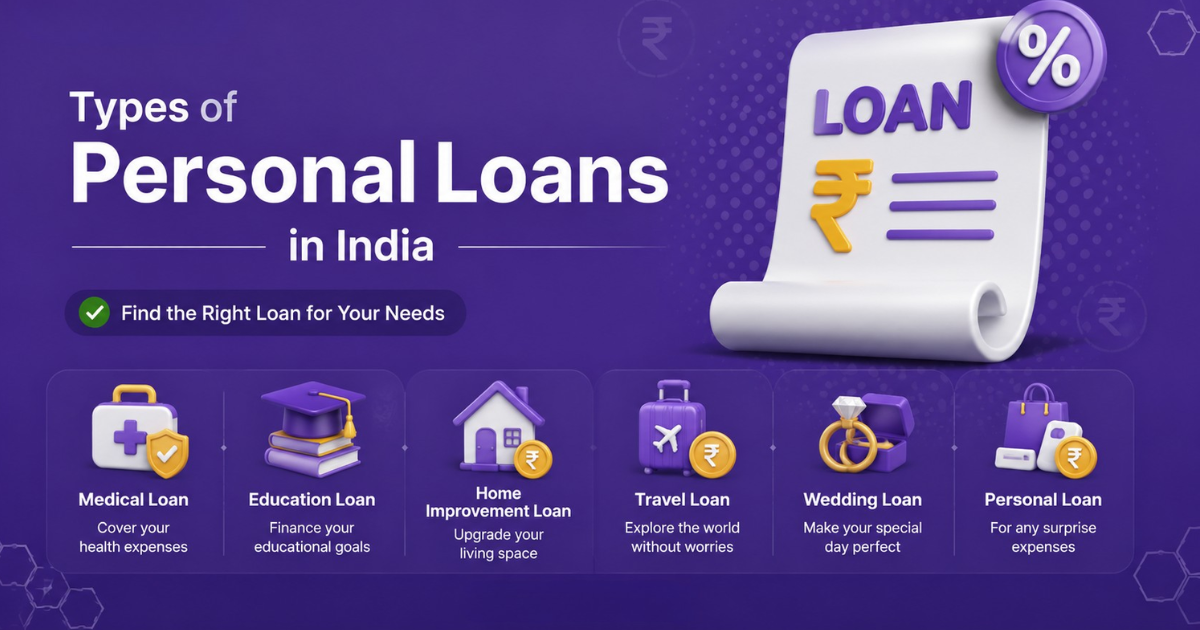
Understanding the different types of personal loans in India can help you choose the right borrowing option based on your financial needs. The financial landscape in India is witnessing a seismic shift. As of January 2026, the Indian banking sector achieved a historic milestone, with total bank credit surpassing ₹200 lakh crore for the first time. In this era of aggressive credit expansion and rigorous regulatory oversight, personal loans have emerged as the primary vehicle for consumption-led growth and financial inclusion.
Whether you are looking to fund a dream wedding, manage a medical emergency, or finance your personal needs, understanding the diverse architecture of the personal loan market is crucial. If you are exploring instant personal loan apps in India with quick approval, choosing the right platform is important. At MoneyMonk, we believe in managing your money with the peace of mind that comes from financial expertise.
This comprehensive guide dives deep into the types of personal loans available in India, the evolving eligibility models, and how digital lending is revolutionizing access to credit.
The Evolution of the Personal Loan Market (2025-2027)
Personal loans in India are no longer just financial tools; they are lifelines that bridge the gap between “just dreaming” and “finally doing”. The market is currently bifurcated into two main streams: high-ticket structural lending and high-volume consumption credit.
While traditional entities focus on large-ticket loans, the fintech sector where MoneyMonk operates has revolutionized the low-ticket segment. Today, you can apply for instant personal loans online without lengthy paperwork and get faster approvals. Although digital lenders account for a smaller percentage of total loan value, they facilitate 76% of the total number of personal loans disbursed in the country, highlighting their vital role in catering to underserved segments.
1, Types of Personal Loans for Salaried Individuals
Salaried professionals remain the most sought-after demographic for lenders due to the predictability of their income. Before applying, it is always better to check your personal loan eligibility online instantly. In the world of unsecured lending, a steady monthly salary acts as a de facto form of security.
The Architecture of Employer Categorization
One of the least discussed but most vital factors in your loan approval is your company’s “category.” Lenders maintain a sophisticated hierarchical system to assess employment stability.
- Super A & Category A: This includes top-tier MNCs, blue-chip listed companies, and central government departments. Employees here often enjoy preferential interest rates, sometimes starting as low as 8.75% to 9.99% p.a.
- Category B & C: Comprising established private firms and medium enterprises. These employees might face stricter eligibility norms for instance, requiring a minimum salary of ₹25,000 compared to ₹15,000 for Super A peers.
- Non-Listed & Startups: While still eligible, employees of smaller enterprises or young startups face deeper scrutiny of income reliability and may pay a risk premium on interest rates
Eligibility and Salary Brackets
Your potential loan amount is determined by your net monthly income and your Debt-to-Income (DTI) ratio. Lenders generally ensure that your total EMI burden does not exceed 40% to 50% of your take-home pay.
| Net Monthly Salary (₹) | Potential Loan Amount (₹) | Typical Tenure |
| 20,000 – 30,000 | 2 – 5 Lakh | 12 – 36 Months |
| 30,000 – 50,000 | 5 – 10 Lakh | 12 – 60 Months |
| 50,000 – 1,00,000 | 10 – 25 Lakh | 12 – 72 Months |
| Above 1,00,000 | 25 – 50 Lakh | 12 – 84 Months |
(Data based on 2026 market projections)
Document Checklist for Salaried Borrowers
Correct documentation is the key to 24-48 hour approvals:
- Identity Proof: Aadhaar, PAN, or Passport.
- Employment Proof: Employee ID card, Offer Letter, or Appointment Letter.
- Income Proof: Last 3-6 months’ salary slips and 6 months’ bank statements showing salary credits.
- Tax Proof: Form 16 or ITR filings.
2. Types of Personal Loans for Self-Employed Individuals
For the self-employed from doctors and CAs to shop owners and traders the underwriting process focuses on business viability rather than a monthly paycheck. Many platforms now allow you to check loan eligibility without affecting your credit score.
Risk Segmentation
- Self-Employed Professionals (SEP): Doctors, Chartered Accountants, and Architects. These individuals often enjoy less stringent norms due to their high qualifications and professional stability.
- Self-Employed Individuals (SEI): Sole proprietors and partners in manufacturing or services. They typically need to show a minimum annual income of ₹1 lakh in metros.
The “No-ITR” Revolution
A significant evolution in 2026 is the rise of “No-ITR” personal loans. Lenders like MoneyMonk utilize cash-flow based underwriting, analyzing bank statements to identify consistent business inflows, rental income, or investment returns. While these loans are highly accessible, they may come with slightly higher interest rates to offset the increased credit risk.
Essential Documents for the Self-Employed
- Business Proof: GST registration, Shop Establishment License, or Certificate of Incorporation.
- Financial Statements: Audited Balance Sheets and P&L accounts for the last 2 years.
- Vintage Proof: Evidence that the business has been operational for at least 3 to 5 years.
3. Instant Personal Loans: The Digital Frontier
The “Instant Loan” is the primary growth engine of modern finance, driven by a 100% paperless process that can disburse funds in as little as 5 to 15 minutes. You can now start your personal loan application instantly from your mobile and get funds quickly.
The Technology Stack Behind Your Approval
- OCR & Authentication: AI systems scan your Aadhaar and PAN for authenticity markers and font consistency to prevent fraud.
- eKYC: Aadhaar-based OTP verification matches biometric data with UIDAI records in under 60 seconds.
Alternative Data Modeling: For those with “thin” credit files, AI analyzes UPI transaction patterns, mobile recharge regularity, and even e-commerce spending behavior to assign a risk score.
MoneyMonk: Your Digital Lending Partner
At MoneyMonk, we offer a 100% compliant, fully digital journey for loans ranging from ₹25,000 to ₹2,00,000. You can apply for a personal loan in minutes and get fast approval without delays.
- Speed: Disbursement is done in minutes after approval.
- Convenience: No upload of scanned documents is required; data is shared through your authentication and consent.
- Transparency: No hidden charges. All fees are disclosed upfront via the Key Fact Statement (KFS) as per RBI mandates.
4. Different Types of Personal Loans in India
To meet specific consumer needs, the personal loan category has been fragmented into specialized products.
Medical Emergency Loans
A lifeline when health crises strike. Unlike health insurance, which may have waiting periods or restricted networks, a medical loan provides instant funds that can be used at any facility for treatments often excluded by insurance, such as cosmetic procedures or post-surgery rehab.
Education Fee Financing
MoneyMonk specializes in Education and Skill Development Fee Financing.
- Flexible Options: Avail low-interest or No-cost EMI options at participating institutes.
- Direct Disbursal: Fees are disbursed directly to the institute on the same day.
- Support: Whether it’s school fees or a professional certification, we help you invest in your future without financial strain.
Wedding and Travel Loans
Indian weddings are lavish affairs, and wedding loans (ranging from ₹1,000 to ₹25 lakh) allow families to cover catering, jewelry, and venues without liquidating long-term investments. Similarly, travel loans often come with bundled travel insurance, making that exotic vacation stress-free.
Home Renovation Loans
While a home loan helps you buy a house, a renovation loan helps you maintain its economic value. These loans offer longer tenures and higher amounts than standard personal loans.
The 2026 Interest Rate Benchmarking
Interest rates are determined by a combination of the lender’s cost of funds, your CIBIL score, and your employer’s category. Always choose transparent personal loan platforms with no hidden charges to avoid extra costs.
| CIBIL Score Range | Risk Assessment | Expected Pricing (p.a.) |
| 750+ | Excellent | Premium (8.75% – 10.5%) |
| 700 – 749 | Good | Competitive (11% – 15%) |
| 650 – 699 | Fair | Standard (16% – 24%) |
| Below 650 | Poor | High-risk (24% – 36%) or Rejection |
Understanding APR: The True Cost of Borrowing
As an expert tip, always look beyond the nominal interest rate. Focus on the Annual Percentage Rate (APR), which includes:
- Processing Fees: Typically 0.5% to 5.9%.
- Prepayment Charges: Usually 2% to 4% of the outstanding principal.
- GST: 18% applied to all fee components.
To understand how lenders determine your EMI and total repayment amount, read our detailed guide on how banks calculate personal loan interest rates.
Regulatory Safeguards: The RBI Digital Lending Directions 2025
To protect borrowers in the digital age, the RBI implemented the Digital Lending Directions 2025. These regulations ensure your safety:
- Direct Transfer: Loans must be disbursed directly to your bank account—no “pass-through” digital wallets.
- Key Fact Statement (KFS): You must receive a clear summary of all costs before signing the contract.
- Data Privacy: All your data must reside on Indian servers and cannot be used to access your contacts or photos.
- Cooling-off Period: You have a specific window to exit the loan without penalty if you change your mind, provided you repay the principal.
Furthermore, as of July 1, 2026, new Ethical Recovery Guidelines prohibit recovery agents from contacting you before 8 AM or after 7 PM.
How to Improve Your Approval Chances: Expert Strategies
Getting approved for a loan at the best terms requires a proactive approach. You can manage your personal loan journey smartly using digital tools to improve approval chances.
- Maintain Your “Financial Karma”: Pay all EMIs and credit card bills on time. A CIBIL score of 750+ is your ticket to the lowest rates.
- Optimize Your DTI: Before applying, try to close smaller existing debts. Lenders prefer a Debt-to-Income ratio below 30-40%.
- Stability is Key: Avoid frequent job changes. Lenders look for at least 6-12 months of continuous employment with the same employer.
- Declare All Income: If you have rental income or dividends, include them in your application to boost your repayment capacity.
- Check the CIMS Registry: Always verify that your chosen digital lending app is legitimately associated with an RBI-regulated entity via the Centralised Information Management System (CIMS)
Conclusion: Manage Your Money Like a Monk
The personal loan market in India is moving toward “regulated maturity,” where technology meets consumer protection. Whether you are a salaried professional seeking a quick top-up or a self-employed entrepreneur looking for cash-flow-based credit, the options are more diverse than ever.
At MoneyMonk, we combine cutting-edge AI processing with the security of an RBI-registered NBFC (Monk Capital Pvt Ltd). Our mission is to make your financial journey easy, transparent, and secure.
Ready to take the next step?
You can apply for a personal loan on the official website or download the app for instant approval and quick access.
Disclaimer: MoneyMonk is a digital lending platform owned and operated by Monk Capital Private Limited, an RBI Registered Non-Banking Financial Company (NBFC), Regn No. N-09.00457. All loans are subject to terms and conditions and credit approval.
No, a personal loan is not treated as income and is not taxable.
Applicants must have a stable monthly source of income above ₹18,000 (with an annual household income greater than ₹3 Lakhs).
While 750+ is ideal, some digital lenders—including MoneyMonk—analyze alternative data transaction patterns to assist those with “thin” credit files.
The entire digital process generally takes no more than 15 minutes, with instant disbursement upon approval.
Missing an EMI attracts late payment charges (36% p.a. penal interest) and negatively impacts your credit score. We always encourage responsible borrowing and timely repayment.


Leave a Reply